

Research Area
On-Going Research: Bacteria
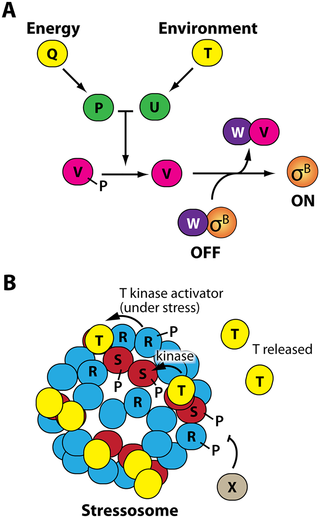
The upstream signaling cascades are illustrated in the figure. Energy or nutritional stress, sensed as the depletion of ATP (the cellular energy currency), is sensed through an unknown mechanism by RsbQ and RsbP—P is a phosphatase that can dephosphorylate V. On the other hand, environmental stress—ethanol, heat, acid, salt, antibiotics, etc.—is sensed by large 80-protein complexes called stressosomes. Stressosomes are composed of RsbR and RsbS proteins, and they also bind to a protein called RsbT. Environmental stressors cause stressosomes to release T in a process that involves T phosphorylating R and S, and the free T then activates RsbU—U is another phosphatase that can dephosphorylate V.
Further complicating things is that the stressosome contains a mixture of four "flavors" (paralogs) of R proteins that are similar but distinct. Why does B. subtilis make these similar but different proteins? Our work thus far has taken advantage of microfluidic technology to uncover differences among these R proteins in their stress-response profiles when responding to ethanol, a classic stressor. We now seek to discover the molecular bases of these differences and to understand how different stress-response profiles can confer survival advantages to cells.
Here are some of the fundamental questions we are asking:
What is actually sensed by the R proteins in the stressosome?
Do the different flavors of R proteins respond differently to different stresses?
What parts of the R proteins govern their distinct response profiles?
Which amino-acid residues play key roles in stress sensing by R proteins?
How do different combinations of R proteins affect overall response profiles?
How do different response profiles confer survival advantages or disadvantages in the presence of different stresses?
As you can see, we have many promising avenues of research. Understanding how different stress-response profiles are generated and how they influence cell survival will give greater insights into the strategies that cells have evolved to maximize their fitness while being prepared for ever-changing conditions.
We are making gains in these areas--please see our Publications page to see our most recent work!
Interested in working on these projects? Contact us—we are always looking for motivated students who love to learn.