Techniques
Pulsed Laser Deposition
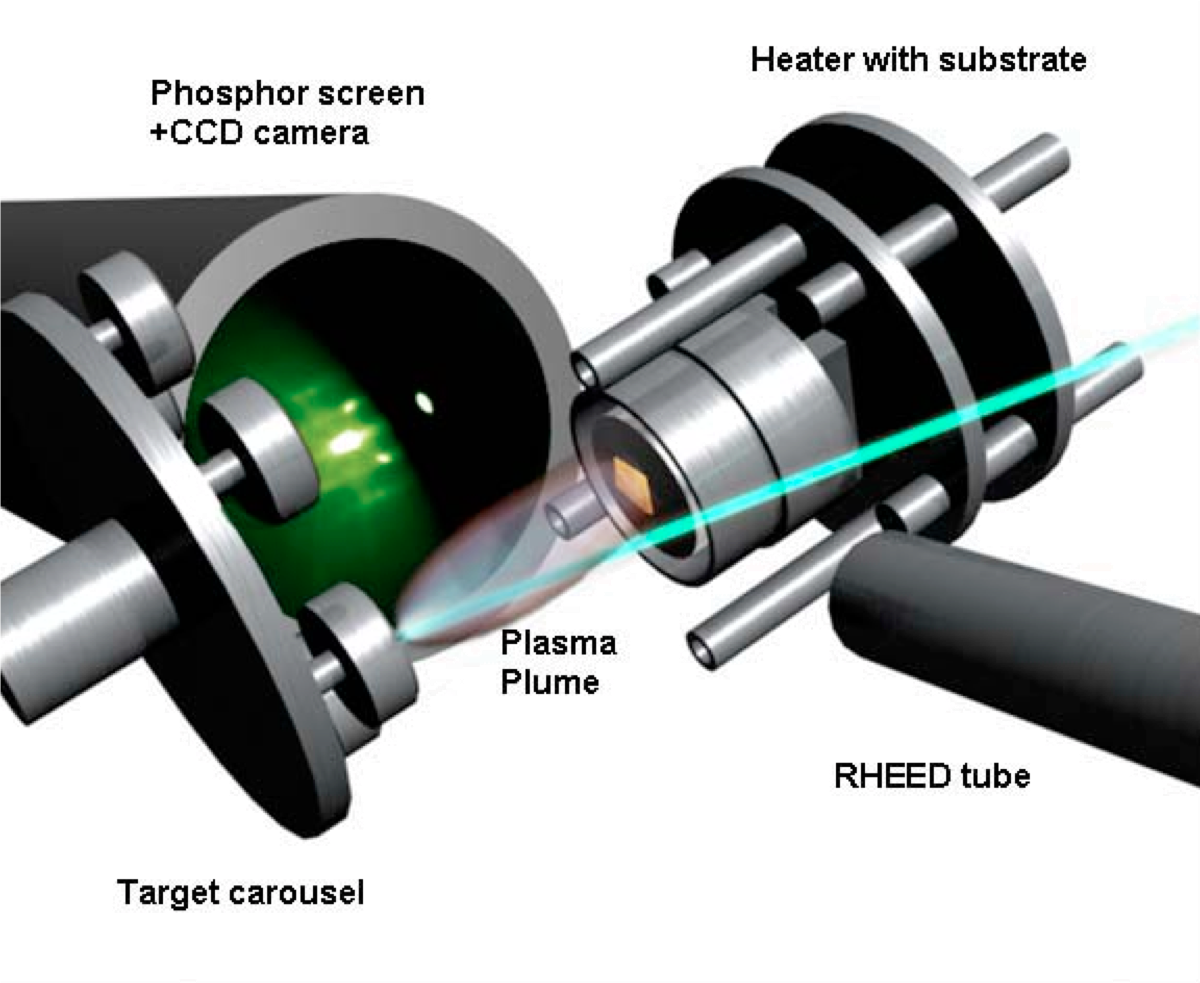
The main reserach tool in our laboratory is the pulsed laser deposition chamber (coming soon!). With this technique a KrF excimer laser ionizes a solid target of material which is then deposited on a crystal substrate creating a thin film. This allows deposition of a single atomic layer of material with high precision and the controlled stacking of different atomic layers to create artificial superlattices. This process is monitored in-situ during deposition with reflection high energy diffraction.
Our Research
Areas of Study
Atomic force microscopy
In order to create high quality thin films, crystal substrates with large, atomically flat terraces are needed. Atomic force microscopy uses a microscopically sharp tip to map the surface morphology of both substrates and the grown films.
X-ray scattering
The lattice structure of the crystal is its most fundamental property and is probed with x-ray scattering or diffraction. This technique uses a focused, monochromatic x-ray beam to measure reflections from the crystal. These reflections reveal the grown crystal structure, mosaicity, and epitaxial relationship with the substrate.
Electronic and magnetic transport
The complex behavior of the valence electrons within oxides is the source of their amazing properties. Insight into these behaviors can be obtained by measuring how these electrons respond to application of electric and magentic fields. We use the Van der Pauw method with both LN2 and helium cryostats to measure resistivity, doping type, carrier mobility and density, and magnetotransport. More advanced transport measurements such as Hall effects are measured with Hall bar geometry achieved with photolithography.
Resonant elastic x-ray scattering
As with resonant x-ray absorption spectroscopy, resonant elastic x-ray scattering is an element specific technique. This measurement allows probing of long-range ordering phenomena of the charge, spin, and orbital states by probing the emergent non-lattice-derived Bragg reflections.
Resonant inelastic x-ray scattering
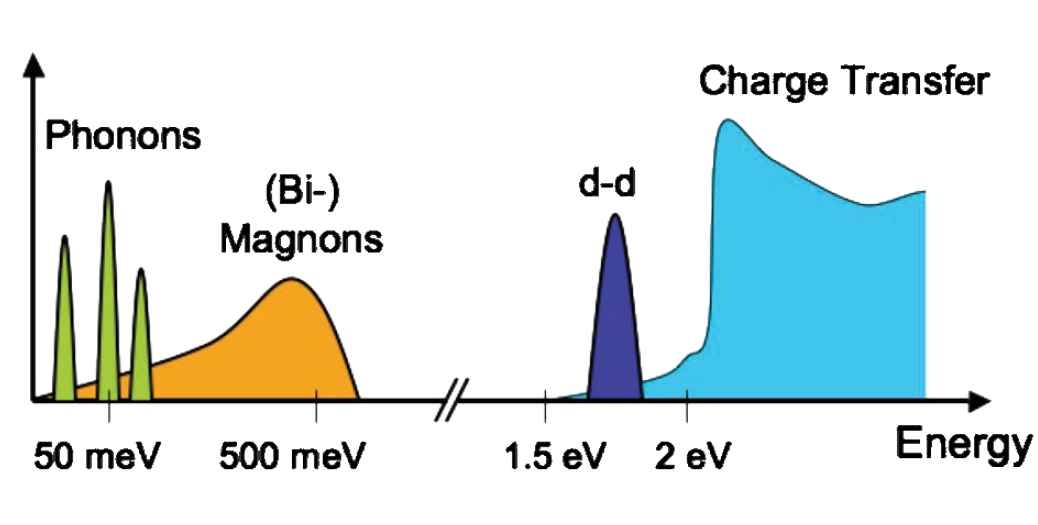
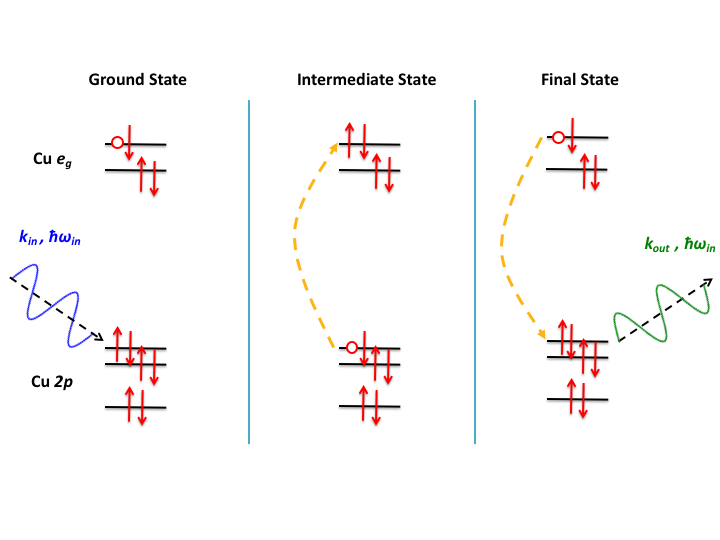
While resonant elastic x-ray scattering probes long range ordering, resonant inelastic x-ray scattering allows investigation of the low-energy excited states in a system, such as magnons, excitons, phonons, and etc. Due to the reciprocal space information obtained through scattering the dispersion of these excitations can also be mapped allowing the coupling paramaters, such as the magnetic exchangeJ, to be extracted.
Resonant X-Ray Absorption Spectroscopy
The electronic occupation of the active elements of ABO3 complex oxides is of fundamental importance for understanding their emergent properties. Resonant x-ray absorption spectroscopy is an element-specific probe that allows extraction of the valence state, orbital occupation, and spin and orbital specific magnetic moments.
Angle-Resolved Photoemission Spectometry
To probe the low energy band structure within these heterostructures, of particular relevance to topological phenomena, angle-resolved photoemission spectroscopy is used. Here the electrons are ejected from the materials with a monchromatic energy source and the resulting emitted electrons are sorted by energy and measured. This technique allows the mapping of both the energy and momentum dispersion of the occupied electronic states near the Fermi level, revealing the band structure.
Luuk J. P. Ament, Michel van Veenendaal, Thomas P. Devereaux, John P. Hill, and Jeroen van den Brink Rev. Mod. Phys. 83, 705 (2011)